
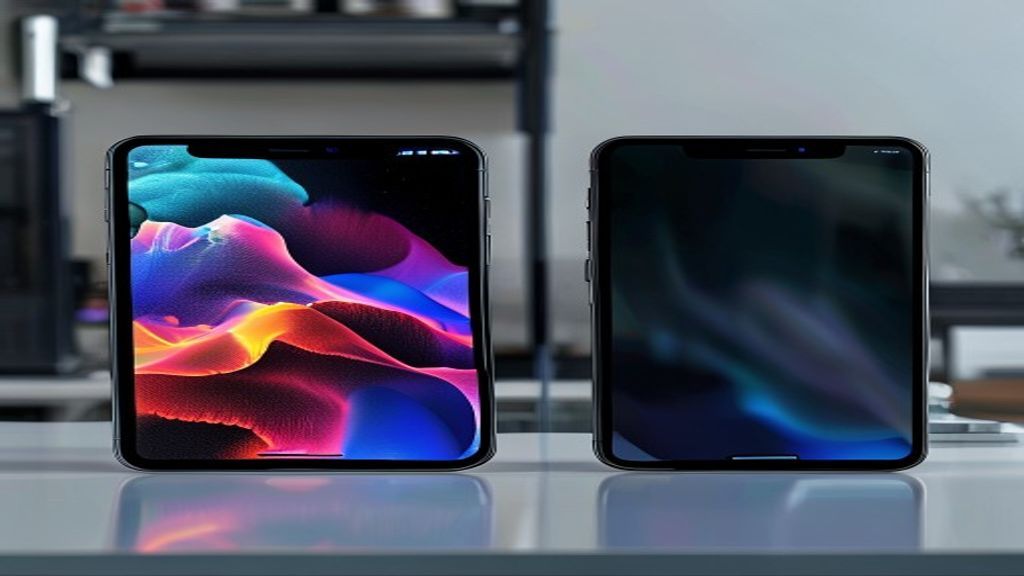
Your phone screen is cracked and you’re shopping for a repair. The shop gives you two options: an LCD replacement for less, or an OLED replacement for more. What’s the difference? Does it actually matter? And is the OLED really worth the extra cost?
As someone who’s replaced thousands of screens since 2014, I’m going to give you the honest answer — and it’s the answer most repair shops won’t tell you because they’d rather sell you the cheaper option.
What’s the actual difference between LCD and OLED?
LCD (Liquid Crystal Display) uses a backlight behind the screen that shines through colored pixels. The backlight is always on, even when displaying black — it just blocks the light. This is why blacks on LCD screens look more like dark gray, especially in a dark room.
OLED (Organic Light Emitting Diode) doesn’t use a backlight at all. Each pixel produces its own light individually. When a pixel needs to be black, it simply turns off completely — true black, zero light. This is why OLED screens look dramatically more vibrant and have that deep, rich contrast that you notice the moment you see one.
Why this matters for your phone repair
If your iPhone 12, 13, 14, 15, 16, or 17 came with an OLED screen from the factory, replacing it with a cheaper LCD means you’re downgrading your phone’s display. Here’s what you’ll actually notice:
Colors will look washed out. OLED screens display a wider range of colors with more accuracy. An LCD replacement will make everything look slightly faded compared to what you’re used to — photos, videos, apps, everything.
Blacks won’t be black anymore. On your original OLED, the black parts of your screen were truly black because those pixels were off. On an LCD replacement, blacks become dark gray because the backlight bleeds through. You’ll notice this most at night or in dark rooms.
The screen may look slightly thicker. OLED panels are thinner than LCD panels because they don’t need a backlight layer. An LCD replacement can sometimes sit slightly higher in the frame, which can affect how cases fit and how the phone feels in your hand.
Battery life may decrease. OLED screens are more power efficient than LCD, especially when displaying dark content. Your phone’s software was optimized for the OLED display — dark mode actually saves battery on OLED because black pixels are turned off. On LCD, dark mode makes zero difference to power consumption because the backlight runs regardless.
Face ID and True Tone may not work properly. Some LCD replacement screens don’t support the full sensor suite that integrates with OLED panels, which can affect Face ID accuracy and True Tone color adjustment.
When LCD is acceptable
There are situations where an LCD replacement makes sense. If you’re replacing a screen on a phone that originally came with LCD — like the iPhone 11 standard model, iPhone XR, or iPhone SE — then LCD is the correct replacement. You’re not downgrading because LCD is what the phone was designed for.
LCD can also make sense if you’re on an extremely tight budget and the phone is old enough that you’re planning to replace it within a few months anyway. Getting a cheap LCD to limp through until your upgrade is a valid financial decision.
When you should invest in OLED
If your phone originally had an OLED display and you plan to keep it for another year or more, invest in the OLED replacement. The difference in daily experience is significant — you’ll feel the downgrade every time you look at your screen. Colors, contrast, battery life, and feature compatibility are all better with a proper OLED replacement.
Think of it this way: you’re already paying for a screen repair. The price difference between LCD and OLED is a fraction of the cost of a new phone. Spending a bit more to maintain the quality your phone was built for is almost always worth it.
How to tell if your phone has LCD or OLED
A quick reference for iPhones: the iPhone 11 (standard), XR, SE, and all models before the iPhone X use LCD. The iPhone X, XS, 11 Pro, 11 Pro Max, and every iPhone 12 and newer — including all Pro, Plus, and Max models — use OLED.
For Samsung: most Galaxy S series phones from the S6 onward use OLED (Samsung calls it Super AMOLED). Budget Samsung phones (A series) use a mix of LCD and OLED depending on the model.
Get the right screen for your phone
At Indiana Phones in Pacific Beach, San Diego, we offer both LCD and OLED screen replacements and we’ll always tell you which one your phone originally came with. We won’t upsell you on an OLED if your phone had LCD, and we’ll explain why OLED is worth it if your phone was built with one.
Founded by Air Force veteran Nicholas, we’ve been doing screen repairs since 2014 with a 4.9-star rating from over 669 customers. Walk in to 1630 Grand Ave in Pacific Beach or call (619) 577-3065 for a free diagnostic and honest recommendation.
Frequently asked questions
What’s the difference between LCD and OLED on a phone?
LCD uses a backlight behind the pixels, so blacks look like dark gray and colors are less vibrant. OLED pixels produce their own light individually, creating true blacks and more vivid colors. OLED is also thinner and more battery-efficient.
Should I replace my cracked OLED screen with a cheaper LCD?
If your phone originally came with OLED and you plan to keep it, investing in an OLED replacement is worth it. Downgrading to LCD means washed-out colors, no true blacks, potentially worse battery life, and possible issues with Face ID and True Tone.
Is OLED screen repair more expensive than LCD?
Yes — OLED panels cost more to manufacture, so the replacement screen is more expensive. However, the price difference is a fraction of buying a new phone, and maintaining your phone’s original display quality is worth the investment for most people.
How do I know if my iPhone has LCD or OLED?
iPhone 11 (standard), XR, SE, and older models use LCD. iPhone X, XS, 11 Pro/Max, and every iPhone 12 and newer use OLED. If you’re not sure, bring your phone in and we’ll tell you — free of charge.
